
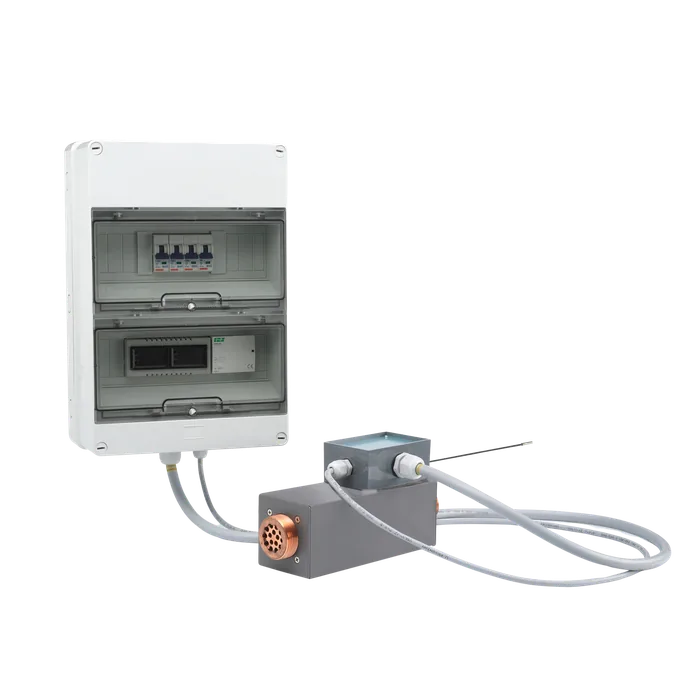
 Classic
AT Modul Classic
- Proven, simple, reliable
- Two-display, button-operated controller in the distribution box
- You set it once and it does its job
- Ideal for one- and two-circuit heating, and it also controls a three-way valve
We don't just claim it. We show you the size, the efficiency and what it costs over 25 years — and you decide.
For people who are building or renovating right now — and are not simply looking for a boiler, but for a decision that still makes sense in twenty years.
We don't start with a quote. We work out which solution fits you — and we'll also tell you if this isn't the one to choose. Ordering comes afterwards, in the web shop.
12 chapters, each answering one question. Jump to the one that interests you — or scroll through in order.
You have to make a long-term decision about heating while every installer tells you something different — and every manufacturer shows you a different number.
One manufacturer emphasises low consumption.
Another one the attractive purchase price.
A third one the impressive performance figures.
Every one of those numbers sounds good.
They just don't mean the same thing.
The real cost of a heating system is made up of at least 6 items:
The real price of a heating system is not the purchase price, but everything it will ask of you over the next 25 years — in money, in space and in peace of mind.
Choosing is hard not because you don't understand the subject, but because you are rarely shown the whole picture.
A heating system is built into your home.
Pipes, cables, surfaces and mechanical components end up around it. Often the floor plan has to be adapted to it as well.
If it later turns out that it takes up too much space, consumes more than you expected, or needs regular repairs, simply swapping it out is no longer enough.
That's when the compromises start:
“It'll last another few years.”
“It would be too expensive to rebuild it now.”
Economical heating isn't only about next month's bill. It's also about how much money, space, time and worry the system asks of you over its entire lifetime.
The calculator works from your building's data — not from a generic example.
The simpler a heating system is, the fewer points it can fail at — and the less you have to rearrange your home around it.
This is the AT Heating Module.
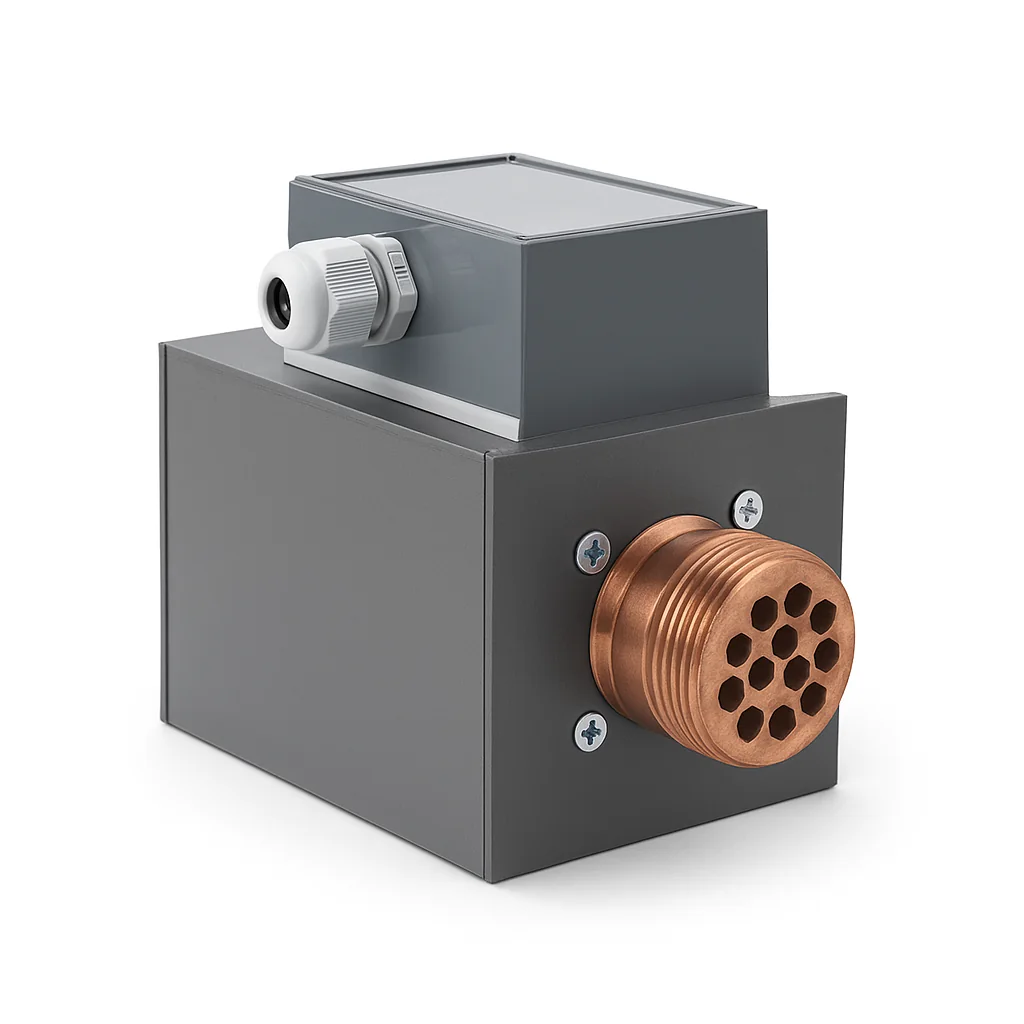
An exceptionally small electric boiler, designed to deliver reliable heat for many years — without unnecessary mechanical complexity.
The smallest model, at 4 kW, measures 80 × 80 × 117 mm — a fraction of the space a wall-mounted gas boiler takes up.
Yet it can heat a 50–70 m² home that meets modern thermal standards.
And it doesn't only heat: with a small indirect cylinder it also handles domestic hot water (DHW), in a fraction of the usual heat-up time.
You don't get a single appliance, but an assembled unit whose parts work together. This is what arrives at your door.
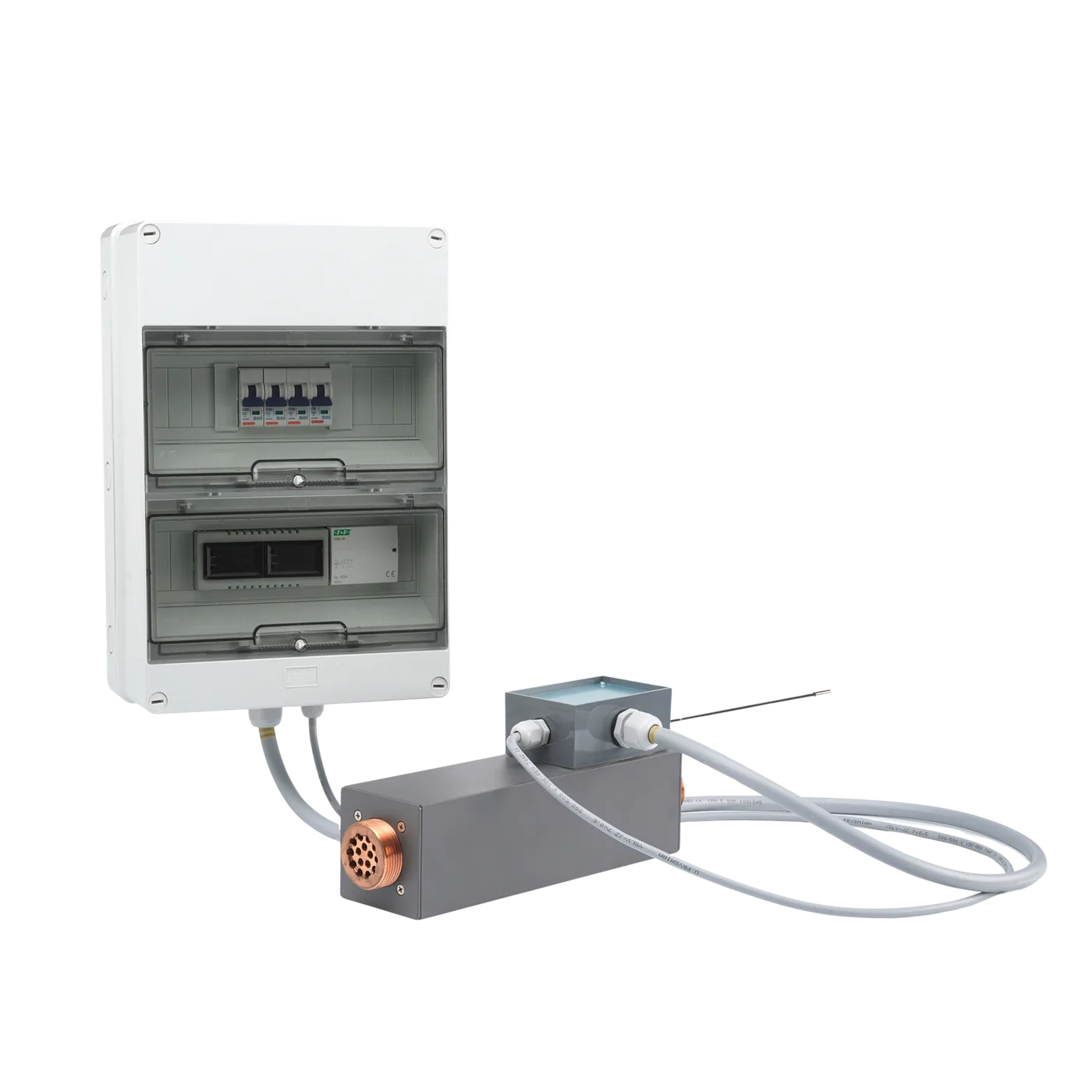
What the Set contains
What the Set does not contain
Hydraulic connectors and safety fittings are not part of the package. The module has 6/4" threaded inlet and outlet. The minimum materials required:
On request, a 3-way valve and an indirect domestic hot water cylinder can be added.
The list of items is the same at every output level. The 4 kW is available in single- and three-phase versions (1 × 25 A or 3 × 10 A), the larger ones are three-phase; the power cable cross-section (1.5 / 2.5 / 4 mm²) and the size of the control box differ.
The heart of both types is the same heating module. You choose how smart the control should be, and how much output your house needs.
Classic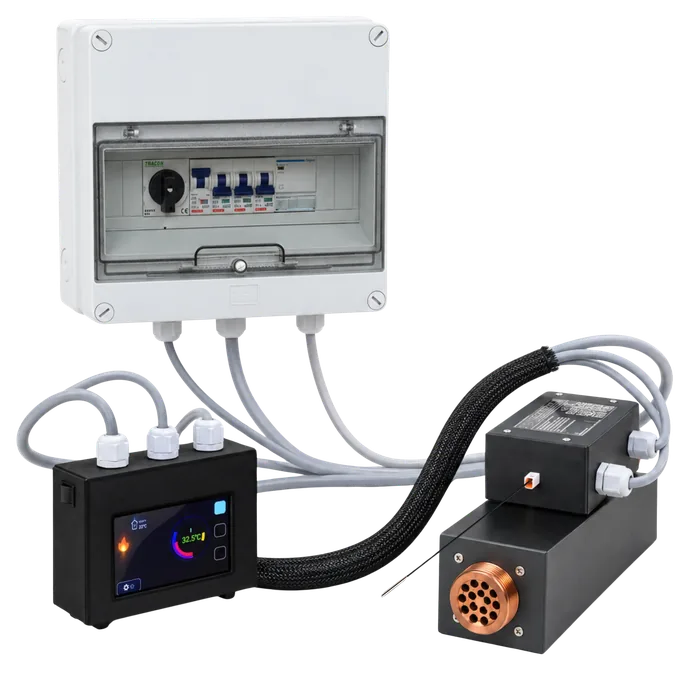 Smart
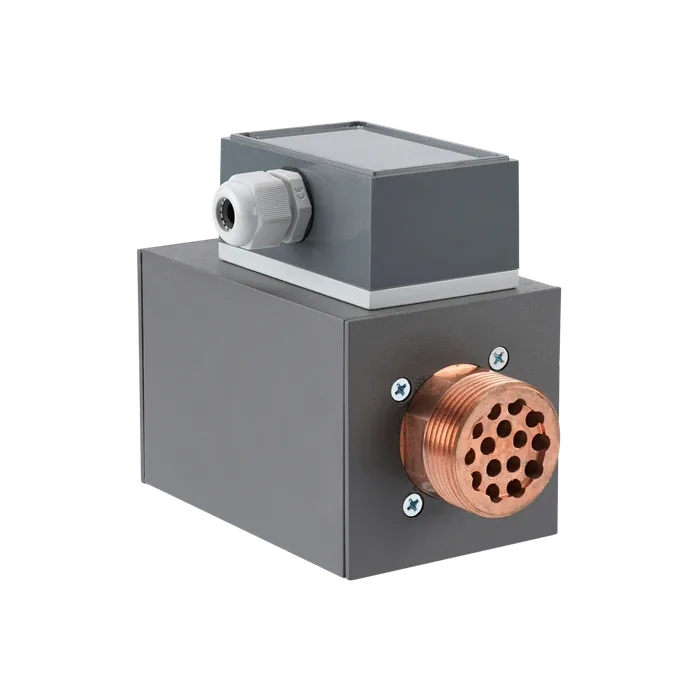 4 kW50–70 m²
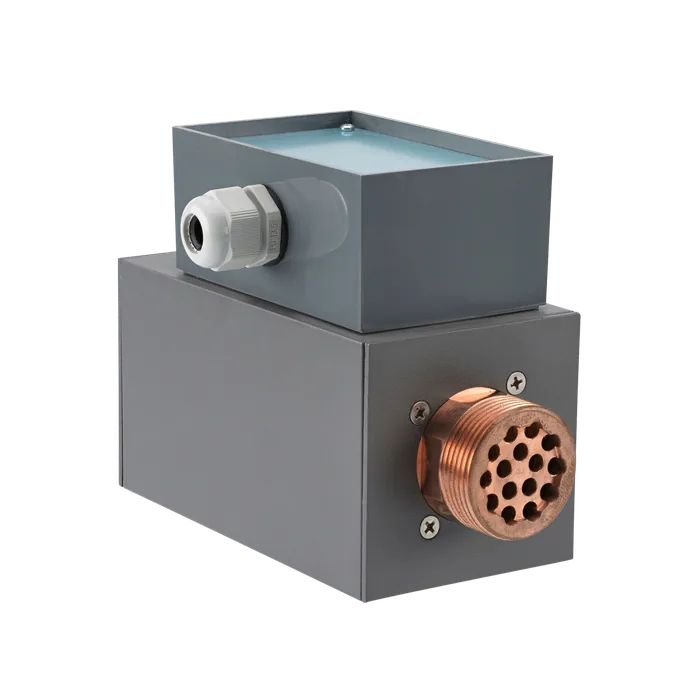 6 kW70–90 m²
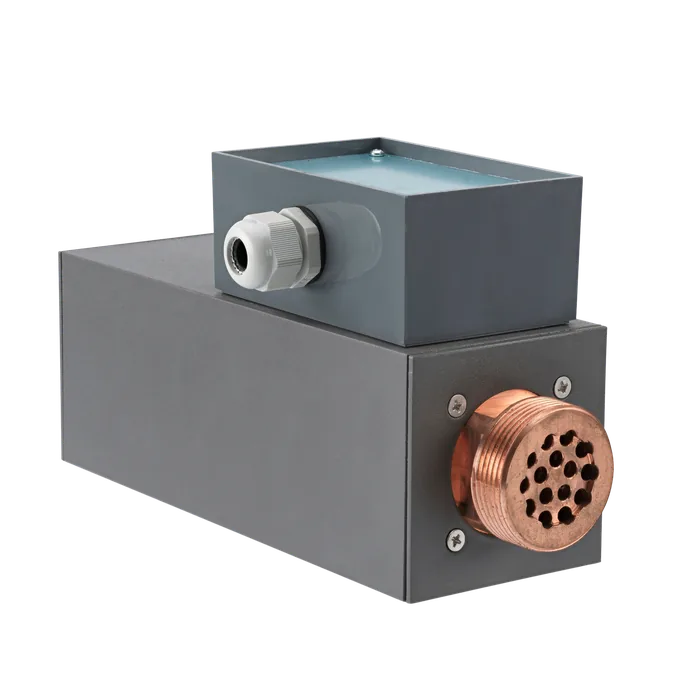 8 kW90–130 m²
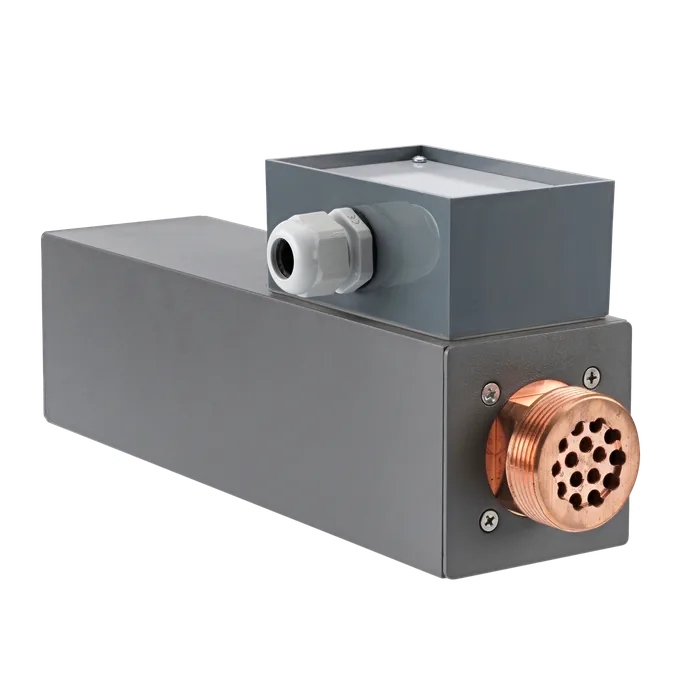 12 kW130–180 m²
The floor areas given apply to buildings without retrofitted insulation — with good insulation the same module can cover a considerably larger area. Further outputs are available on request. Which one is right for you is not decided by floor area alone — work it out with the calculator, where insulation thickness is taken into account as well.
The AT Heating Module heats the water circulating in your heating system — exactly as your gas boiler did before. That is why your existing water-based system can often stay in place.
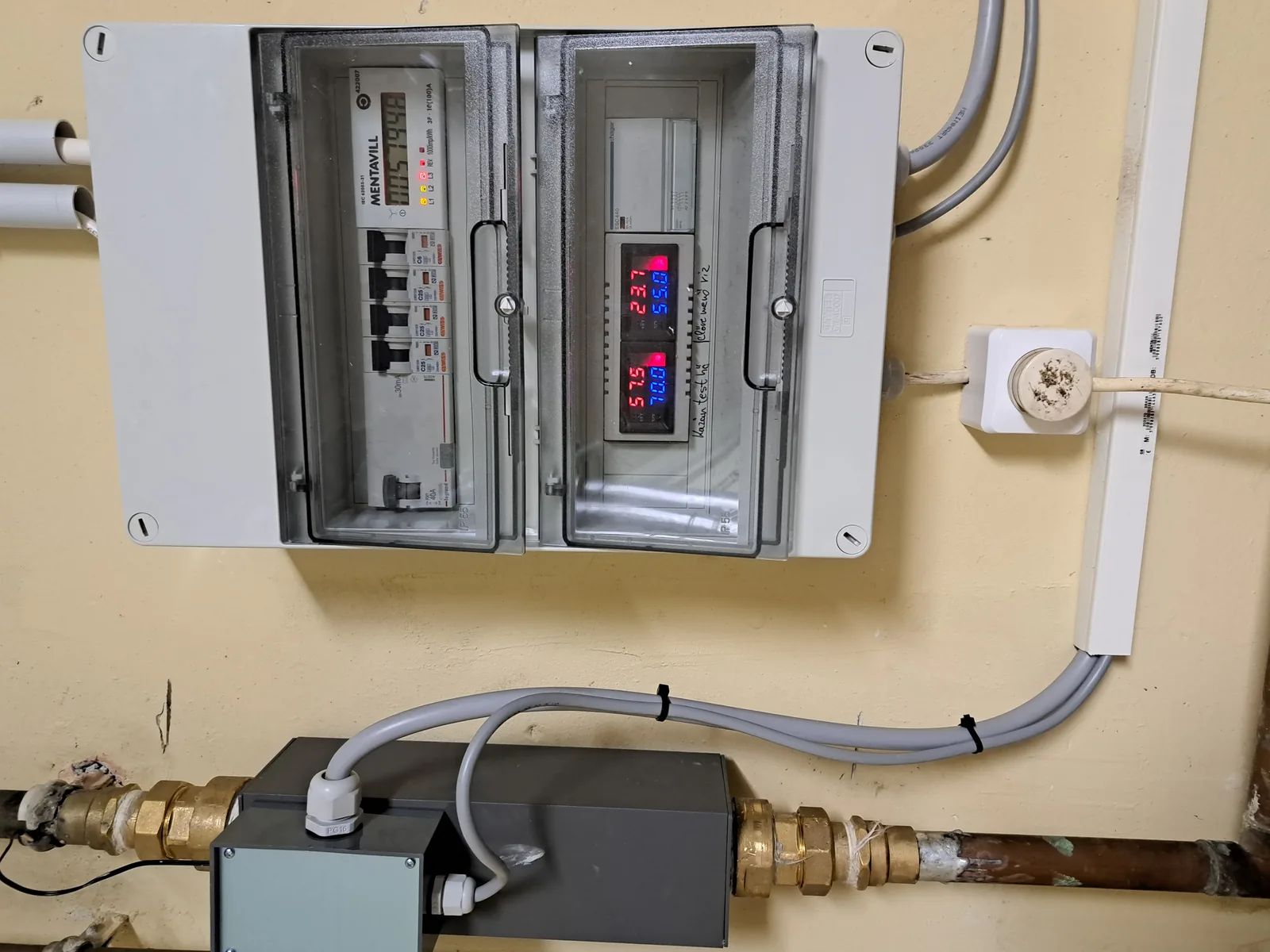
In a new build, the system can be designed from the start so that no gas connection, chimney or separate boiler room is needed at all.
For a small daily hot water demand, a simple water heater can be an economical choice. For a larger family or a significant demand, however, the maths is entirely different with an indirect cylinder.
A smaller indirect cylinder is enough
Because the cylinder refills quickly, there is no need to keep a large volume hot — it takes up less space, and less energy is lost to standby.
Very short heat-up time
Heat can be transferred at high power through the heat exchanger, so the cylinder reaches the target temperature in a fraction of the time a conventional electric water heater needs.
No limescale build-up
The heating module works in the closed heating circuit, not in the domestic water. There is no heating element immersed in the domestic water for limescale to coat and insulate.
Stable, high efficiency
Efficiency does not decline over the years through limescale — by the nature of the technology there is nothing for it to settle on. What is true in the first year is still true in the tenth.
The radiators or underfloor heating must be properly sized and able to deliver the required heat at the water temperature the AT Heating Module provides. In old iron-pipe systems, fitting a magnetic dirt separator is essential.
We check whether the necessary electrical capacity is available and whether the supply needs upgrading. This is the one condition that most often means extra work — which is why we say so up front.
We don't look at floor area alone. We take into account insulation, windows and doors, ceiling height, current energy consumption and the type of heat emitter system.
Because an oversized boiler is money wasted. An undersized one doesn't give you the security you bought it for.
In all three comparisons, what the AT Heating Module does better and what it doesn't get exactly the same amount of space.
It does the same job — without combustion, chimney or gas connection.
Where the AT Heating Module is better
Where it isn't — and what to weigh up
The same energy source — but not the same efficiency, and not the same service life.
Where the AT Heating Module is better
Where it isn't — and what to weigh up
A heat pump may consume less. The AT Heating Module costs less, takes up less space, and has less in it that can break.
Where the AT Heating Module is better
Where it isn't — and what to weigh up
In winter the AT heats. In summer the air conditioning cools. Each does what it is good at.
The comparison here is general. The calculator compares it with your current heating.
Installation costs roughly the same in both cases. The difference is how many times you have to pay for it — and that once the warranty runs out, repairs are no longer a one-off item but a running cost.
The calculation is an example based on the 4 kW version. Prices vary by country — you'll get the figures for your own market during the consultation.
Conventional electric boiler
€500–1,000 · service life 5–8 years · factory warranty 2–5 years
AT Heating Module — 4 kW
€2,080 · minimum 25-year design life · 20-year replacement warranty
The calculation compares one thing only: what it costs to heat the same house over the same 25-year period, with a conventional electric boiler and with an AT Heating Module.A 4 kW-os kivitelre vonatkozik.
Favourable case — the boiler lasts 8 years with a 5-year warranty and repairs cost €100: 4 × (500 + 400) = €3,600, plus 2 repairs at €200 — €3,800 in total.
Unfavourable case — the boiler lasts 5 years with a 2-year warranty and repairs cost €200: 5 × (1,000 + 800) = €9,000, plus 8 repairs at €1,600 — €10,600 in total.
The same for the AT Heating Module: €2,080 + one-off installation of €400–800 = €2,480 – 2,880. We did not include repair costs, because of the 20-year replacement warranty.
The calculation does not include energy costs or their future changes, nor the individual mechanical items involved in installation. These differ from building to building and from country to country — during the consultation we recalculate with your home's data.
Efficiency tells you how much of the electricity you feed in actually becomes heat. The higher it is, the less you pay for the same amount of heat — every single month, for 25 years. And by the nature of the technology this figure does not deteriorate over the years, because there is nothing for limescale to settle on.
Over a full heating season, in buildings with identical characteristics, the AT Heating Module produced the same amount of heat from about 15.6% less electricity than the conventional element-type electric boiler tested.
This is the result of our own operational comparison. The figure is valid only against an electric heating element — not against a gas boiler and not against a heat pump.
Not the lowest purchase price. The route that leaves the most money in your pocket over 25 years.
For every reference we show the same few figures, so you can compare them with your own building. The map marks real, completed installations.
The sizing logic is the same everywhere: it is the building's heat demand that decides, not its function. Several modules can run in parallel, so buildings with higher heat demand can be served too.
Minimum 25-year design life, 20-year replacement warranty.
We don't expect you to simply take our word for it that the AT Heating Module is long-lived. We back it with a warranty that shows how much we trust the design.
We can do this because the appliance contains no moving wear parts — there is no compressor, no fan and no mechanical unit under continuous motion. The fewer wear parts there are, the fewer points there are that can demand a costly repair over the years.
We provide the manufacturer's warranty on top of your statutory consumer rights — not instead of them, and without limiting them.
The main unit contains no moving wear parts: no compressor, no fan and no other component under constant mechanical load.
We show you before the purchase what the warranty covers, and which component we cannot offer the same on.
When we ask you for a long-term decision, we have to take on long-term responsibility ourselves. That is why the purpose of the warranty is to make sure the risk of the main unit failing is not carried by you alone.
If the registration is missed or the documentation is interrupted, the warranty falls back to the standard 3 years — your statutory rights, however, remain untouched. Claiming the replacement warranty does not restart the 20 years.
Incorrect choice of output, undersized electrical supply, unsuitable pipework; use contrary to the intended purpose, disregarding the manual; poor water quality, ingress of air, leakage, pump or flow failure; fluid harmful to the copper body; overvoltage, lightning strike; acts of nature; mechanical damage or opening of the casing.
The warranty applies in the country where you bought and installed the appliance. That is why we ask for the country and region of installation with every enquiry.
The full warranty certificate arrives with the appliance, and can also be requested before purchase.
In these cases the 25-year total cost typically works in your favour.
If any of these is true for you, we will say so during the consultation — even if it costs us the sale.
At the end we'll also tell you if the AT Heating Module isn't the right choice for you.
A long warranty is worth as much as the company behind it. That is why we put it on the table how long we have been here.
Designing a heating system is a profession of its own, and that is not what we do. What we provide is the appliance, the technical data needed for sizing, and a well-founded estimate of which output suits your building.
The detailed design and the installation are done by your own designer and contractor — and we give them all the documentation they need for it. If you don't have a professional, we are happy to recommend one who has already worked with the AT Heating Module.

Zoltán Fenyvesi
Over the decades I have worked with 23 inventors and a great many unusual technical solutions. Of those 23 projects I kept only 3.
The AT Heating Module is one of them.
It didn't start with a touching story. It started with a question.
In 2015 I got access to an unusual heating technology, and I became curious: could a boiler be built that is smaller, simpler and longer-lived than anything we knew until then?
I didn't want to cram more features into a machine. I wanted it to do one important job really well: to give reliable heat, with the least possible space, the fewest parts and the fewest later problems.
Over the years I learned something that is hard to get from books: a good idea is not yet a good product. A genuinely good product has to work reliably in a real home, it has to be repairable, and years later it still has to deliver what the owner originally bought it for.
After several years of development, this is what the AT Heating Module grew out of.
Because a heating system is not an impulse purchase — you live with it for decades. So for me, success isn't that you say yes today. It's that you don't regret it later.
A few questions about your building, and we'll show which AT Heating Module Set could be an option. If you have existing gas or oil consumption figures, we'll use those — they are the most accurate starting point.
The warranty and the price depend on the place of installation, which is why we ask for the country and the region.
Choose a category and only the questions that interest you will open.
The AT Heating Module is an exceptionally small boiler that runs on electricity alone.
It heats the water circulating in the heating system, which then heats your home through radiators, underfloor heating or other water-based heat emitters.
It does the same basic job as a conventional gas boiler — only without burning gas, without a chimney and without flue gas.
Yes. The AT Heating Module needs nothing but an electrical connection of adequate capacity.
It uses no gas or other fuel, and there is no combustion process in it.
If you don't need gas for cooking or hot water either, with the right system design gas can be dispensed with entirely in the property.
The smallest, 4 kW module measures 80 × 80 × 117 mm and weighs 3.2 kg. The larger versions have the same cross-section, they are only longer: the 12 kW one is 271 mm.
The small size is not just an eye-catching technical curiosity. It makes it possible to place the appliance right next to the buffer tank or the point of use.
This can mean shorter pipe runs, and less heat lost while the heat is being transported.
The output required depends not on the physical size of the appliance, but on the heat demand of the property.
Heating a properly insulated property of about 50–70 m² that meets today's thermal standards is a common use case.
A poorly insulated building with high heat loss, however, may need considerably more output for the same floor area. That is why sizing is always necessary.
The product is available in 4 kW, 6 kW and 12 kW versions among others, and further outputs may also be available.
We don't select the right model on floor area alone.
We also take into account the building's heat loss, insulation, windows and doors, ceiling height, heat emitter system and previous energy consumption.
No. The AT Heating Module is made for heating; it does not provide active cooling.
For cooling, a separate air conditioner or heat pump solution can be used.
In some homes it can be entirely rational for the AT Heating Module to do the heating, while the heat pump or air conditioner only handles cooling in summer.
In many cases, yes.
If your current system is water-based, the AT Heating Module can take over the role of the old gas boiler and heat the heating water from electricity.
Before switching, the property's heat demand, the required flow temperature, the heat emitters and the capacity of the electrical supply have to be checked.
In many cases yes, but this has to be checked technically.
The radiators can be used properly if they can deliver the heat needed to warm the property at the water temperature the AT Heating Module provides.
We don't automatically start by replacing radiators. First we examine whether the existing system is suitable for continued use.
Usually not.
If the existing water-based underfloor heating is in good condition, the pipework in the floor can continue to be used. In such cases it is typically the heat generator and the related mechanical components that have to be changed.
The exact arrangement can be determined after a technical inspection on site or based on the plans.
If the AT Heating Module takes over the gas boiler's heating job entirely, you no longer use gas for heating.
The energy needed appears on your electricity bill instead.
If you continue to use gas for cooking or hot water, the gas bill will of course not disappear completely.
Not necessarily.
If your gas boiler runs reliably, no major repair is due and you buy gas at a good price, it may be more economical to keep running it.
Switching can become particularly justified if you are facing a boiler replacement, an expensive chimney refurbishment, gas design work, permitting or a significant system rebuild.
We will also tell you if, based on the figures, it isn't worth switching yet.
With existing gas heating, one of the most useful figures is last year's gas consumption.
It gives a good starting point for estimating how much heat energy the property needed over a year.
We supplement this with the floor area, the insulation data, the windows and doors, the ceiling height and the characteristics of the current heating system.
The electricity bill you can expect depends primarily on the heat demand of the property.
Heating a well-insulated house takes far less energy than a poorly insulated building of the same size.
So instead of a generic consumption promise, we produce a calculation from your home's data. Before you decide, we also show how your total energy cost could change.
There is no single consumption figure that applies to every property.
Consumption is affected, among other things, by:
On the basis of annual gas consumption or a heat loss calculation, however, the amount of electricity required can be estimated well in advance.
In a study in Austria, the heating systems of 3 identical houses were monitored over a full heating season.
According to the measurements, the AT Heating Module produced the same amount of heat from 15.6% less electricity than the conventional electric boiler tested.
Important: the comparison was made with a conventional electric boiler, not with a heat pump.
The electricity consumption of a heat pump can generally be lower.
When comparing total costs, however, it is worth looking not only at the electricity bill, but also at the price of the appliance, the installation, regular servicing, spare part replacements and the expected service life.
The advantage of the AT Heating Module lies mainly in its simpler design, its few wear parts, its small footprint and its long service life.
Because the total cost of a heating system does not consist of a single monthly bill.
It also includes:
A system with lower consumption can still cost more overall if it is expensive to install, needs frequent maintenance or has to be replaced sooner.
With certain system designs, and depending on the applicable supply terms, it may be possible to use more favourable tariffs.
In many cases this requires heat storage.
With underfloor heating, the several tonnes of concrete can itself act as a heat store. In other systems, heat produced during the cheaper period can be stored in a buffer tank.
The exact tariff conditions and eligibility always have to be checked separately.
Not in every system.
With underfloor heating, the heated concrete mass itself has significant heat storage capacity.
In other arrangements, a 1,000, 1,500 or even 2,000 litre buffer tank can help you produce the heat during a cheaper period and use it later.
Whether it is needed can always be decided on the basis of the particular property and heating system.
Yes.
How economical it is, however, depends on the size of the solar system, the annual generation, the distribution of consumption over time and the current settlement arrangement.
For a property with solar panels we therefore prepare a separate calculation rather than giving a generic savings promise.
If you have the opportunity, it is worth reducing the building's heat loss first.
Better insulation can bring savings in 3 places:
That is why, in a renovation, insulation is often a more important first step than the boiler replacement itself.
Yes, but this isn't the most economical solution in every case.
The AT Heating Module may be able to produce the water temperature needed for bathing directly, but with a small daily hot water demand a simple water heater can be the more economical choice.
For a larger family or a significant hot water demand, the maths with an indirect cylinder can be entirely different.
If one or two of you live in the property and you use little hot water, it often isn't worth using the more valuable heating module for just a short time each day for this.
In such cases a simple electric water heater can be the more rational solution.
We say this honestly even when selling a larger system would be more advantageous for us.
A water tank in which the water is not heated by a conventional electric element.
The AT Heating Module transfers the heat to the domestic hot water through a heat exchanger coil running inside the tank.
Since the output of the heating module can be far greater than the element of an average water heater, the water can be reheated more quickly.
With correct sizing, yes.
With a conventional water heater a larger tank is needed because reheating the water takes longer.
An AT Heating Module of adequate output with an indirect cylinder can replace the hot water used much faster, so for some families a smaller tank can be enough.
The exact size has to be determined from the size of the family and their usage habits.
The supply capacity required depends on the output of the chosen heating module and on the property's other electrical loads.
Before installation the following have to be checked:
We clarify this before the order is placed.
Yes, it may.
If the property currently doesn't have the electrical capacity needed to run the heating module and the other household appliances at the same time, an upgrade may be required.
That is why it matters that the supply conditions don't only come to light on the day of installation.
The AT Heating Module burns no gas or other fuel, so it needs no chimney and no flue gas system.
No gas design work is required either.
The electrical connection and any supply upgrade, however, may require dealing with the utility or a qualified electrician.
The AT Heating Module itself needs no separate boiler room.
Because of its small size it can be placed, for example, in a wardrobe, under a washbasin, behind a kitchen counter or right next to the mechanical system.
Space does of course have to be provided for the other elements of the complete system — a larger buffer tank or indirect cylinder, for instance.
How long installation takes depends on whether it is a new build, a simple boiler replacement or a more complete mechanical rebuild.
Connecting to a properly prepared, existing water-based system can be far simpler than building a complete heating network.
The actual time needed can be determined after surveying the system.
The appliance has to be installed by professionals with the appropriate electrical and building services expertise.
It matters that the installer knows the hydraulic, control and electrical requirements of the system.
We provide technical information and consultation for professionals.
The main unit of the heating module contains no compressor, fan or other continuously moving mechanical part.
This reduces the maintenance that wear would otherwise require.
The other elements of the complete heating system — the circulation pump, the controls, the safety fittings and the water quality — do, however, have to be checked just as in any water-based system.
There are few points of failure in the main heating unit.
The appliance does, however, contain an electronic control board of about 10 × 7.5 centimetres. The electronic components on it can fail during the service life and may need replacing.
We don't hide this in the small print of the warranty conditions.
When designing the appliance we worked with an operating life of at least 25 years.
The long service life is made possible by the small number of wear parts and the simple design.
The actual service life is of course also affected by correct sizing, professional installation, the electrical environment and the condition of the complete heating system.
The 20-year replacement warranty covers the main unit of the AT Heating Module, subject to the conditions set out in the warranty document.
The same 20-year commitment does not apply to the electronic control board.
Before you buy, you can review exactly what the warranty covers, on what conditions and with what exclusions.
First it has to be established whether the fault arose in the main unit of the heating module, in the control board or in some other element of the heating system.
If the failure concerns the unit covered by the replacement warranty and the warranty conditions are met, we proceed according to the warranty.
The detailed procedure is set out in the warranty documentation.
More than 99% of the appliance is made of recyclable materials.
Because of its long service life and the few parts that need replacing, fewer appliances and components may end up as waste in the environment.
The environmental impact of operation, however, also depends on the source of the electricity used. We therefore do not claim that it is completely carbon neutral under all circumstances.
We generally ask for the following information:
The more accurate the data we get, the more reliable the recommendation we can give.
No.
The purpose of the consultation is first of all to establish whether the AT Heating Module could be a technically and economically suitable solution for your home.
If the figures show you'd be better off with another solution, we'll say that honestly too.
We go through the data you have sent and, if necessary, ask for further technical information.
We then determine the recommended appliance output, the electrical and mechanical conditions, and any additional components that may be needed.
On that basis you receive a specific output and system recommendation. Ordering comes afterwards, in the web shop or through your own contractor.
We organise open days and opportunities to see the appliance in person.
There you can hold the appliance, see it running, and put your technical questions directly.
We give information about the next opportunity after you register your interest.
A live video demonstration may also be possible.
In that case we don't show a pre-recorded promotional film: we show you the appliance live and you can ask your questions as we go.
This way you can satisfy yourself that it is a real, working product, without travelling.
Depending on the sites available and the consent of the customers, working installations may also be open to visits.
This always requires registering and arranging a time in advance.
We give information about the specific options after you register your interest.
Yes.
We provide a separate technical consultation option for contractors, building services designers, architects, resellers and other professional partners.
We go through sizing, installation, system integration and the terms of cooperation.
Send it to us together with your building's details.
You won't get a generic answer, but one that fits your home, your existing system and your energy demand.
All three start in the same place: we look at what the AT Heating Module can do in your situation. We don't begin with a quote, but with advice.
Building, renovating or facing a boiler replacement? We'll tell you which output could work and what it costs in total.
If you'd like to look at the figures yourself first, here is the output calculator.
The consultation doesn't commit you to buying. If we think another solution suits you better, we'll say so honestly.
Sales+36 70 304 0188 · [email protected]
Are you a contractor, building services designer or architect? We will show you the technical background so you can design it into your projects.
Design is a profession of its own — we add the manufacturer's side, we don't take your work away.
Iroda+36 70 883 4555 · [email protected]
Would you take the product to your own market as a reseller or distributor? We are also looking for international partners.
You can choose from 4 entry levels:
We don't publish specific price levels and terms — we go through those in a personal discussion.
Partnerkapcsolat[email protected]
A good heating system doesn't only give peace of mind to the owner of the home. It also gives the designer and the contractor something they can still stand behind proudly decades later.